.svg)
.svg)
.svg)




Data Recovery for Law Firms: A Step-by-Step Guide to Saving Critical Evidence
Imagine arriving at the office on Monday morning to find that a departing employee wiped their entire workstation, taking months of discovery documents with them. With 39% of law firms reporting a data breach or loss in the past year, this nightmare scenario is becoming a common reality for many practitioners. When you’re facing the stress of a potential malpractice suit or a missed court deadline, professional data recovery for law firms becomes your most critical line of defense. It’s a high-stakes crisis where every second counts, and the integrity of your evidence is on the line.
We understand that restoring lost files isn’t just about technical success; it’s about protecting the attorney-client privilege and ensuring a secure chain of custody. You need a solution that respects the sensitive nature of your practice while acting with the speed your deadlines demand. In this guide, you’ll learn the exact forensic steps to recover Outlook PST files, PDFs, and vital discovery materials without compromising their admissibility in court. We’ll provide a clear, step-by-step protocol for emergencies that moves your firm from technical failure to total resolution. By the end, you’ll have the tools to restore your digital well-being and keep your client’s trust intact.
Key Takeaways
- Understand why maintaining a forensic chain of custody is essential to ensure your recovered files remain admissible in court.
- Identify the critical differences between logical software errors and physical hardware failure to choose the most effective restoration path.
- Discover why common DIY fixes and free recovery software often cause permanent data loss for sensitive discovery materials.
- Master a professional emergency protocol for data recovery for law firms that begins with an immediate power-down to protect failing equipment.
- Learn how to move from reactive recovery to proactive protection by utilizing specialized cybersecurity tools and managed IT services.
Why Data Recovery for Law Firms Requires a Forensic Approach
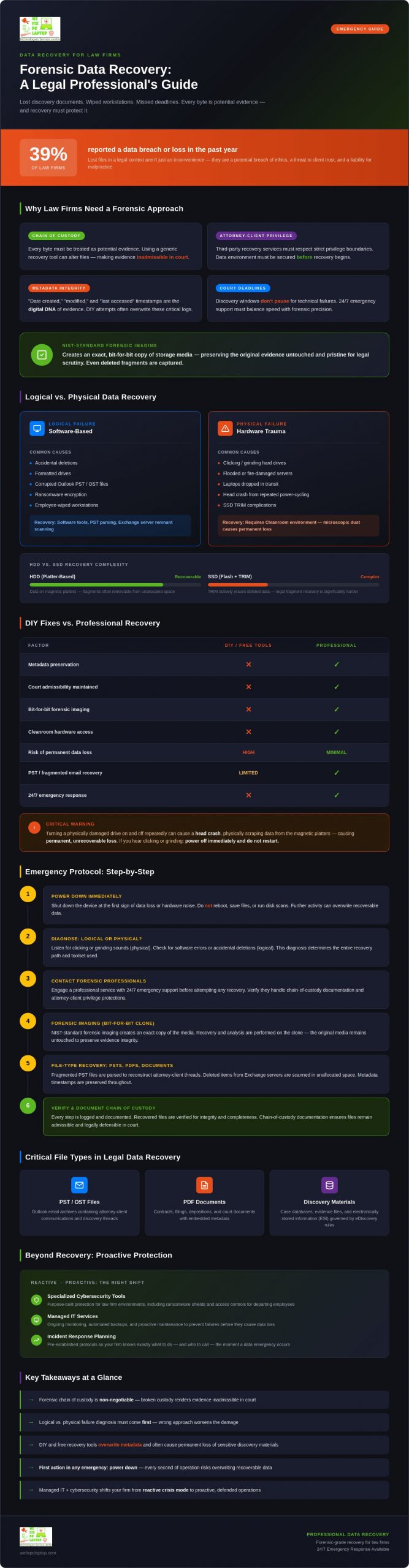
For a legal professional, a lost file is never just an inconvenience; it’s a potential breach of ethics and a threat to a client’s future. Legal data recovery is the specialized process of retrieving lost files while maintaining absolute forensic integrity. Unlike standard IT fixes, data recovery for law firms must treat every byte as potential evidence. If you use a generic recovery tool, you risk altering the very files you need to save, which can lead to evidence being declared inadmissible or thrown out of court entirely.
Maintaining a chain of custody is vital when handling sensitive client information. You aren’t just looking for a lost PDF; you’re preserving the digital truth. When a third-party recovery service handles your drives, they must respect the strict boundaries of attorney-client privilege. Common scenarios like ransomware attacks or a disgruntled employee wiping their workstation require a delicate, expert touch. We focus on securing the data environment first, ensuring that no further damage occurs while we work to restore what was lost through our in-house depot repairs.
The Critical Nature of Metadata in Legal Cases
Metadata is the digital DNA of your evidence. The “date created,” “date modified,” and “last accessed” timestamps tell the story of a document’s history. These details are fundamental to the rules of electronic discovery, which govern how digital evidence is identified and preserved. Improper DIY recovery attempts are dangerous because they often overwrite critical file system logs during the boot process. Professional data recovery for law firms utilizes NIST-standard forensic imaging to create an exact, bit-for-bit copy of the storage media, ensuring the original evidence remains untouched and pristine for legal scrutiny.
Urgency and Court Deadlines: The SLA Factor
Court-mandated discovery windows don’t pause for technical failures. When a filing deadline is looming, the pressure is immense. This is where 24/7 emergency tech support becomes a lifesaver for your firm. We balance the need for speed with the meticulous nature of bit-for-bit drive cloning. While a standard file copy might be faster, a forensic clone ensures that even deleted fragments are captured for review. Our goal is to provide a rapid response that satisfies both the judge’s timeline and the rigorous standards of forensic science. We act as your dependable local ally, moving you from a state of technical crisis to a point of total resolution before the court bell rings.
Logical vs. Physical Data Recovery: What Law Firms Need to Know
When your firm’s data vanishes, the first question we ask is whether the failure is logical or physical. This distinction determines the tools we use and the likelihood of a total resolution. Logical recovery handles software-based issues like accidental deletions, formatted drives, or corrupted Outlook PST and OST files. Physical recovery, on the other hand, deals with hardware that has suffered trauma, such as clicking hard drives, flooded servers, or laptops dropped during transit to a courtroom. Effective data recovery for law firms begins with an accurate diagnosis to ensure no further damage occurs to the storage media.
Physical drive surgery is a delicate process that requires a specialized Cleanroom environment. Opening a drive in a standard office introduces microscopic dust particles that can cause permanent data loss by interfering with the drive’s internal components. If you hear a grinding or clicking sound, stop immediately. Turning the device on and off again can cause a physical head crash, scraping the data right off the magnetic platters. You should also be aware that SSD recovery differs significantly from traditional HDD recovery. While HDDs store data on platters, SSDs use flash memory and a process called TRIM, which can make recovering deleted files much more complex in a legal context where every fragment of evidence matters. For a deeper understanding of what this process involves, our guide on professional hard drive recovery service and secure data restoration explains the full scope of what a forensic hardware restoration entails.
Recovering Deleted Emails and Client Communications
Email is the backbone of legal discovery, yet it’s often the first thing to go missing due to accidental wipes or server errors. We use advanced techniques to parse fragmented PST files, reconstructing attorney-client threads that appear to be gone forever. Even if items were “permanently deleted” from an Exchange server, we can often find data remnants in unallocated space. Ensuring these communications remain forensically sound is our top priority, allowing you to present recovered evidence with total confidence in its integrity.
RAID and Server Recovery for Firm-Wide Databases
A failed practice management server can paralyze your entire office. Multi-disk RAID arrays offer some redundancy, but when the controller fails or multiple drives drop offline, you need expert intervention. Developing a robust disaster recovery plan helps firms avoid these panic-inducing moments before they happen. If you’re wondering how these systems fit into your overall security, you might ask, what is an IT service provider? and how can they help stabilize your firm’s infrastructure? When a legal practice management server goes down, the stakes for data recovery for law firms reach their peak because an entire firm’s history is at risk. If you are currently facing a server crash, our emergency onsite support services are ready to step in and save your critical evidence.
The Risky Truth: Data Recovery Companies vs. DIY
When you realize a critical case file is missing, the impulse to download “Free Recovery Software” is strong. Don’t do it. These programs are designed for home users looking for vacation photos, not for legal professionals protecting privileged evidence. Most free tools require installation on the same drive where the data was lost, which can permanently overwrite your client files. In the high-stakes environment of data recovery for law firms, a single mistake during the initial moments of a crisis can turn a recoverable file into a permanent loss. We’ve seen too many firms lose everything because they tried a “quick fix” that destroyed the disk’s file structure.
The financial stakes make the choice even clearer. While a standard hard drive recovery service might cost between $350 and $1,900, the average cost of a data breach for law firms reached $5.08 million in 2026. A lost malpractice suit or a court sanction for missing evidence far outweighs the price of professional help. A professional data recovery company doesn’t just give you back your files; they provide the “Chain of Custody” documentation you need. This paperwork proves the data wasn’t tampered with during the recovery process, a level of verification that DIY methods simply cannot offer.
When DIY is an Absolute No-Go
If your device is making any unusual noise, stop immediately. Clicking, grinding, or a drive that won’t spin are clear indicators of physical failure. Amateur tools can’t handle failing sectors or “bit rot,” and they often stress the drive until it suffers a total head crash. Creating a forensic bit-stream image is the only safe way to start a recovery because it captures every sector without making a single change to the source drive. Without this exact clone, you’re gambling with the only copy of your evidence.
Choosing a Secure Data Recovery Partner
Security is just as important as the recovery itself. You must evaluate potential partners based on their NDAs and data privacy protocols, ensuring they meet SOC 2 or legal industry standards. We believe our In-House Depot Repair is the safest option because your drive never leaves our secure facility, reducing the risk of data theft during transit. If you’re feeling overwhelmed by the options, our guide on how to choose between data recovery companies can help you make an informed decision. Trusting a local ally who understands the weight of attorney-client privilege ensures your firm’s reputation stays protected throughout the entire process.
How to Handle a Data Emergency: A Step-by-Step Guide for Law Firms
The moment you realize vital case files have vanished, the clock starts ticking against your court deadlines. Your first actions determine whether the data is gone forever or merely temporarily inaccessible. Successful data recovery for law firms depends on a calm, methodical response that prioritizes the physical state of the media and the legal integrity of the evidence. Follow this emergency protocol to maximize your chances of a total resolution.
- Step 1: Power down immediately. If a drive is failing, every second it remains powered on increases the risk of a permanent head crash. Don’t attempt to browse files or run “check disk” utilities. Pull the plug or hold the power button until the device is completely dark.
- Step 2: Document the circumstances. Note exactly who was using the device, what software was running, and any unusual sounds or error messages. This information is a vital part of the forensic trail and helps technicians narrow down the cause of failure.
- Step 3: Secure the hardware. Place the affected drive or laptop in an anti-static bag to prevent electrostatic discharge. Lock the device in a secure area, such as a firm safe or a restricted server room, to maintain a controlled environment.
- Step 4: Contact a specialized expert. Reach out to a recovery partner with specific experience in the legal sector. They understand the nuances of attorney-client privilege and the technical requirements of forensic imaging.
- Step 5: Establish the chain of custody. Before the drive is picked up or shipped, create a log that tracks the device’s movement. This ensures that the evidence remains admissible by proving it was never left in an unsecured or unmonitored state.
Immediate Actions for Ransomware Attacks
If you see a ransom note on your screen, your firm is under active attack. Isolate the infected device from your network immediately by unplugging the ethernet cable or disabling the Wi-Fi. This prevents the encryption from moving laterally to your firm-wide databases or backups. You should never pay the ransom without consulting a recovery expert first; many decryption keys provided by attackers fail to work or contain further malware. For a more detailed strategy, review our Ransomware recovery plan guide to understand your options for business continuity.
Preparing for the Recovery Consultation
When you speak with a technician, be ready to identify the most critical files you need for immediate court filings. Providing a list of specific file types, such as Outlook PST archives, discovery PDFs, or DOCX briefs, allows the team to prioritize those sectors during the recovery process. Once the diagnostic report is ready, review it carefully to understand exactly what can be saved. If you are currently facing a digital crisis and need a tech-savvy lifesaver, contact us for 24/7 emergency onsite support to secure your evidence today.
Beyond Recovery: Protecting Your Firm with Managed IT and Cybersecurity
While successful data recovery for law firms provides immediate relief during a crisis, the ultimate goal is to move from reactive fixes to proactive protection. Law firms are prime targets for cyberattacks because they hold concentrated, sensitive client data, litigation strategies, and financial records. In 2026, the legal industry faces an average of 1,055 attacks per week. Staying ahead of these threats requires more than just luck; it requires a sophisticated defense system. By integrating advanced tools like SentinelOne for endpoint detection and Atakama for high-security encryption, you can stop data theft before it even starts.
Maintaining business continuity is about ensuring your firm never grinds to a halt. Our 24/7 onsite support services provide a safety net that lowers your stress levels during technical hiccups. Whether it’s a server failure or a workstation glitch, having a dependable local ally means you aren’t waiting for a call back while a court deadline looms. We focus on restoration and speed, ensuring your digital well-being is always protected. This proactive approach transforms your IT from a source of anxiety into a foundation of professional authority.
Implementing a Robust Disaster Recovery Plan
A disaster recovery plan is only as strong as its last test. We implement cloud backup solutions that offer both versioning and “air-gapped” security. Air-gapping ensures that a copy of your data remains physically isolated from the network, making it unreachable for ransomware that tries to encrypt your backups. You must remember that an untested backup is a liability, not a solution. Regularly verifying that your data can be restored in minutes is essential for meeting your ethical obligations to protect client information. For a deeper look at the tools available, explore our guide on cybersecurity solutions for professional firms.
Why We Fix PC Laptop is the Legal Sector’s Tech Ally
Security and integrity are at the heart of everything we do. One of the biggest risks in the industry is shipping sensitive drives to third-party labs where you lose control over the chain of custody. We solve this through our In-House Depot Repair services. Your drives never leave our secure facility, ensuring that your sensitive discovery materials and privileged communications remain under our expert care. We are a tech-savvy lifesaver for firms that value personal connection and professional secrecy.
We take pride in being more than just a repair shop; we are your dedicated IT consultant for your law office. Our commitment to 24/7 emergency response and expert hardware restoration means we are always available when you need us most. Don’t wait for the next data emergency to secure your firm’s future. Reach out to Ken today for a secure consultation on your firm-wide IT health and move from a state of technical failure to total resolution.
Secure Your Firm’s Digital Future Today
Don’t let a sudden technical failure turn into a long-term legal catastrophe. We’ve explored how a forensic approach to data recovery for law firms preserves the chain of custody while saving critical evidence from failing hardware. By following a strict emergency protocol and choosing professional restoration over risky DIY attempts, you protect your firm’s reputation and your clients’ sensitive data. Every byte of evidence matters when a court deadline is approaching, and having a reliable plan in place is your best defense against permanent data loss.
As specialized IT consultants for law offices, we’re here to act as your tech-savvy lifesaver. We combine in-house expertise with advanced security tools like Atakama and SentinelOne to ensure your data stays private and protected at all times. Whether you need immediate restoration or a proactive roadmap to prevent future breaches, our 24/7 emergency onsite support is ready to move you from a state of crisis to total resolution. Take the first step toward securing your firm’s most valuable assets right now.
Get a Secure Data Recovery Consultation for Your Law Firm and regain your peace of mind. Your evidence is too important to leave to chance, and we’re dedicated to helping you win the race against time.
Frequently Asked Questions
Is it possible to recover data from a laptop that won’t turn on?
Yes, we can usually retrieve your files because the storage drive often remains intact even when the motherboard or power supply fails. Our technicians bypass the laptop’s power issues by removing the internal drive and using forensic imaging tools to create a secure bit-stream copy of your data. This allows us to access your discovery documents and privileged communications without needing the original device to boot up.
How long does the data recovery process typically take for a law firm?
Most recovery cases are resolved within 24 to 72 hours, though the exact timeline depends on the severity of the drive’s damage. While logical recoveries involving accidental deletions are often faster, physical repairs requiring drive surgery in a cleanroom environment take more time. We prioritize speed to help you meet court-mandated discovery windows while maintaining the meticulous care required for legal evidence.
Will our client data remain confidential during the recovery process?
Your client data remains strictly confidential through our use of comprehensive NDAs and advanced security tools like Atakama and SentinelOne. Because we perform in-house depot repairs, your sensitive files never leave our secure facility or pass through the hands of third-party vendors. We treat every drive with the high level of professional secrecy that your firm and your clients expect.
Can you recover data from a drive that has been encrypted by ransomware?
Recovery from ransomware is often possible by identifying the specific malware variant or restoring data from hidden shadow copies and unallocated space. We focus on forensic reconstruction to bypass the encryption and retrieve your critical legal files without you having to pay a ransom. Our team acts as a tech-savvy lifesaver to help you regain control of your firm’s digital assets after a cyberattack.
Do you provide a technical report that can be used as evidence in court?
Yes, we provide a detailed forensic report that documents every step of the recovery process and verifies the integrity of the restored files. This report is essential for proving that the data hasn’t been altered or tampered with during the procedure. It provides the technical foundation you need to satisfy your discovery obligations and ensure the recovered data is reliable for court proceedings.
What is the “Chain of Custody” and why is it important for our firm?
The “Chain of Custody” is a chronological log that tracks the movement and handling of your hardware from the moment we receive it. This process is vital for data recovery for law firms because it ensures your evidence remains admissible in court. By documenting a clear path of possession, we prove that the digital evidence remained secure and pristine throughout the entire recovery cycle.
How much does professional data recovery for law firms cost?
The cost of professional recovery is an investment in your firm’s reputation and its ability to avoid malpractice suits. The final price depends on whether the issue is a simple logical error or a complex physical failure that requires specialized hardware restoration. We provide a thorough diagnostic report before starting any work so you can make an informed decision based on the specific needs of your case.
Can you recover files that were deleted by a former employee months ago?
We can often recover files deleted months ago if the sectors on the drive haven’t been overwritten by new data. Success depends on the drive’s activity level since the deletion occurred, but our forensic tools are designed to find remnants of PST and PDF files in the drive’s unallocated space. If the workstation was powered down shortly after the deletion, your chances of a total resolution are significantly higher.
- How to Recover Data from a Failed Hard Drive: Step-by-Step
- Professional Hard Drive Recovery Service: Secure Data Restoration for 2026
- The Ultimate Guide to Laptop Repair: Restoring Performance and Data in 2026
- Comprehensive IT Services and Support for Healthcare: The 2026 Practice Readiness Guide
- How to Choose Between Data Recovery Companies: A Complete 2026 Comparison Guide
- Ransomware Recovery Plan: A Comprehensive Guide for Business Continuity