.svg)
.svg)
.svg)


IT Services for Healthcare Providers: A 2026 Guide to Managed Technology Services
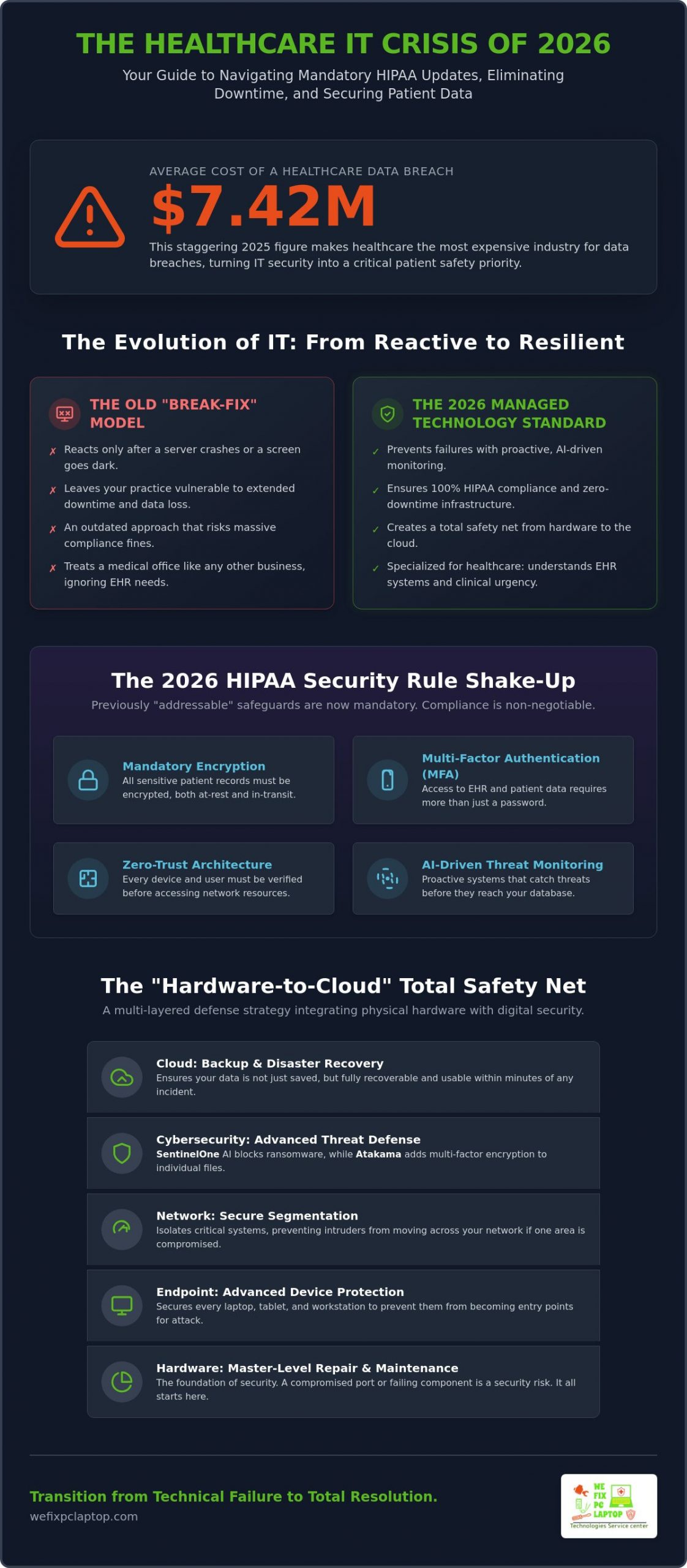
Did you know that the average cost of a healthcare data breach reached $7.42 million in 2025? This staggering figure, the highest of any industry, is why finding the right it services for healthcare providers is no longer just an IT decision; it’s a patient safety priority. We know the anxiety that comes with ransomware threats and the frustration of fighting with slow EHR systems while patients wait. With the 2026 HIPAA Security Rule updates now making previously optional safeguards mandatory, the pressure to maintain a perfect compliance record is heavier than ever.
You shouldn’t have to choose between modern efficiency and data security. This guide explores how specialized managed technology can protect your practice from massive fines and eliminate the threat of downtime. We’ll walk you through a “Hardware-to-Cloud” security model that ensures 100% HIPAA compliance and keeps your data secure yet accessible across every device. You’re about to learn how to build a resilient, zero-downtime infrastructure that lets you stop worrying about technical crises and start focusing on your patients again. It’s time to transition from a state of technical failure to a state of total resolution.
Key Takeaways
- Stop reacting to tech failures and start preventing them by moving away from outdated “break-fix” models that leave your practice vulnerable to downtime.
- Ensure your practice meets the strict 2026 HIPAA updates by implementing mandatory encryption and multi-factor authentication through specialized it services for healthcare providers.
- Protect your patient data and eliminate daily EHR frustrations with advanced endpoint protection and secure network segmentation designed for medical environments.
- Use our 2026 buying guide to vet potential partners for their medical credentials and their ability to provide immediate, local on-site support when every second counts.
- Learn the advantage of a “Hardware-to-Cloud” approach that combines expert cybersecurity with master-level hardware repair to create a total safety net for your facility.
The Evolution of IT Services for Healthcare Providers in 2026
The evolution of Health Information Technology (HIT) has shifted from simple technical support to a core survival strategy. In 2026, it services for healthcare providers are no longer just about resetting passwords or setting up printers. They represent a specialized subset of managed technology services that treats your practice’s digital health with the same rigor you apply to your patients. The old “break-fix” model, where you only call a technician when a screen goes dark or a server crashes, is effectively dead. For a modern clinic, waiting for a failure means risking a data breach that costs an average of $7.42 million. That’s a price tag no practice can afford to pay.
This year marks a turning point with the finalization of the HIPAA Security Rule updates in May 2026. These changes have turned previously “addressable” suggestions into mandatory requirements. We’ve moved toward a zero-trust architecture where every device and user must be verified, backed by AI-driven monitoring that catches threats before they reach your database. True protection now requires a seamless integration of hardware maintenance and digital security. If your laptop’s physical port is compromised or its screen fails during a critical patient update, your security is only as good as the hardware it runs on. It’s about creating a total safety net that covers you from the chip to the cloud.
Why General IT Support Isn’t Enough for Doctors
General IT companies often treat a medical office like a standard retail shop. They don’t understand the heavy lifting required by modern EHR systems like Epic or Oracle Health. A ten-minute lag in these systems isn’t just an annoyance; it’s a disruption to patient care and a massive financial leak. Specialized it services for healthcare providers understand these unique pressures. They focus on zero-downtime infrastructure because they know that in a clinical setting, technical speed equals better patient outcomes. We focus on keeping your tools fast so you can stay focused on care.
The 2026 Regulatory Landscape
Regulators have redefined “reasonable effort” in 2026. Simply having a firewall isn’t enough anymore. With the new federal requirements for substance use disorder records and mandatory multi-factor authentication, the compliance bar is higher than ever. This has birthed the concept of “Compliance-as-a-Service,” where your IT partner proactively manages audits and technical testing schedules. It’s about moving from the fear of massive fines to the confidence of a fully shielded practice. We help you stay ahead of these changes so you’re never caught off guard by an unexpected audit or a new mandate.
Core Components of Managed Technology Services for Medical Practices
Building on the 2026 shift toward zero-trust architecture, modern it services for healthcare providers must deploy a multi-layered defense. It starts with the hardware in your hands and extends to the encrypted cloud. A secure practice isn’t built on a single software suite; it’s built on a carefully engineered stack of tools designed to facilitate a Secure Health Information Exchange while blocking every possible entry point for intruders. We focus on creating a environment where your data is always protected, even if a single device is lost or stolen.
Cybersecurity Architecture: SentinelOne and Atakama
Traditional antivirus software is no longer a match for the sophisticated ransomware of 2026. We utilize SentinelOne, which employs advanced AI to monitor file behavior in real-time. If it detects a suspicious encryption attempt, it can instantly roll back the system to its safe state. Complementing this is Atakama, a tool that provides multi-factor encryption for your most sensitive patient records. This means that even if a hacker gains access to your network, they cannot open individual files without physical authorization from a secondary device. Together, these tools create a vault-like environment for your EHR that keeps patient privacy intact even under direct attack.
Cloud Backup and Disaster Recovery
There’s a critical difference between having a backup and having a recovery plan. A simple backup might save your files, but a disaster recovery plan ensures you can actually use them within minutes of a failure. We follow the strict 3-2-1 backup rule for all medical data: three copies of your data, stored on two different types of media, with one copy kept securely off-site in the cloud. This redundancy is essential because 33% of healthcare ransomware incidents in 2025 began with exploited vulnerabilities that could’ve been mitigated by rapid restoration. If you’re concerned about your current readiness, reviewing a comprehensive ransomware recovery plan is a great first step toward total business continuity.
Beyond backups, we implement 24/7 monitoring to catch threats before they penetrate the network. We design custom network segments with high-security firewalls specifically tailored for the high-traffic needs of medical offices. This prevents a breach in a guest Wi-Fi network from ever touching your patient records. If you’re ready to secure your practice with a partner who understands these medical complexities, you can explore our cybersecurity solutions to see how we protect local clinics and ensure their digital well-being stays a top priority.
Case Study: Streamlining a Multi-Specialty Clinic with Managed IT
Imagine a clinic with 15 busy providers where the EHR system lags every time a doctor tries to update a patient record. This was the reality for a local multi-specialty facility we partnered with. They were struggling with aging laptops and a non-compliant data storage system that felt like a ticking time bomb, especially with the 2026 HIPAA Security Rule updates looming. They needed specialized it services for healthcare providers that could handle both the hardware failures and the complex regulatory requirements without disrupting patient care.
Phase 1: Infrastructure Assessment and Hardware Overhaul
Our team started with a deep audit of every workstation and server. We discovered that over half of the clinic’s laptops were more than four years old, lacking the processing power to handle modern EHR encryption requirements. We didn’t just suggest new computers; we implemented a hybrid cloud model that allowed for better data accessibility while keeping sensitive records behind a master-level security wall. By integrating managed it support services, we ensured that their long-term stability was protected by experts who understand the high stakes of medical data and hardware reliability.
Phase 2: Implementing Zero-Trust Security
Once the hardware was stabilized, we moved to the digital perimeter. We deployed SentinelOne across all clinical endpoints to stop ransomware threats in their tracks. However, technology is only half the battle. We spent time training the intake staff on new security protocols, ensuring they could verify identities and secure patient data without slowing down the check-in process. We also completely segmented the guest Wi-Fi from the internal medical network. This meant a patient in the waiting room could browse the web without ever coming near the clinic’s private database, closing a major security gap that many general IT providers overlook.
The transformation was immediate. Within three months, the clinic reported a 40% increase in staff efficiency because they were no longer waiting for screens to load or systems to reboot. Most importantly, they achieved 100% HIPAA audit readiness. They transitioned from a state of constant technical anxiety to a state of total resolution. This is the power of choosing the right it services for healthcare providers; it turns technology from a hurdle into a tool for better patient care.
Evaluating Managed Service Providers: A 2026 Buying Guide
Selecting the right partner for it services for healthcare providers is a decision that impacts every facet of your practice, from the front desk to the exam room. In 2026, you can’t afford to hire a generalist who “does a little bit of everything.” You need a team that understands the weight of the current $7.42 million average data breach cost and the urgency of a frozen EHR screen. While many providers promise “99.9% uptime,” it’s vital to understand what that actually means. That small 0.1% of downtime can equal nearly nine hours of lost productivity per year. For a busy clinic, those nine hours represent hundreds of missed appointments and thousands in lost revenue.
Local expertise remains your greatest asset in a crisis. When a server room floods or a critical workstation won’t boot, a technician in a call center three states away can’t help you. You need a partner with immediate onsite support and robust in-house repair capabilities to minimize your hardware downtime. True it services for healthcare providers should bridge the gap between digital security and physical hardware restoration, ensuring your practice stays operational regardless of the technical challenge.
Questions to Ask Your Potential IT Partner
Before signing any agreement, you must verify that your partner is willing to share the legal burden of compliance. Start with these three essential questions:
- Do you provide a Business Associate Agreement (BAA)? If they won’t sign a BAA, they aren’t a healthcare IT partner; they’re a liability.
- How do you handle emergency onsite support for hardware failures? Ask for specific response times for physical repairs that can’t be handled remotely.
- Can you manage our professional in-house depot computer repair needs? Having a partner who can fix a MacBook or a PC laptop in-house saves you from weeks of waiting for manufacturer shipping.
Total Cost of Ownership (TCO) vs. Monthly Fees
Don’t just look at the monthly bill. Consider the total cost of ownership for your technology. Managed services often reduce long-term capital expenditure by preventing the “emergency buy” cycle that happens when systems fail. Proactive security is always cheaper than a single data breach. For practices that are scaling quickly, utilizing computer rental for business can provide the hardware you need without the massive upfront investment. This flexibility allows you to keep your staff equipped with modern, secure devices while maintaining a predictable budget. If you’re ready to partner with a team that values your practice’s success as much as you do, you can contact our experts today for a comprehensive technology assessment.
Why We Fix PC Laptop is the Trusted Lifesaver for Healthcare IT
Ken and the team at We Fix PC Laptop operate on a technician-owned philosophy that prioritizes the person behind the screen. We don’t view you as a ticket number; we see you as a valued member of our community who needs reliable tools to provide essential care. Many it services for healthcare providers focus solely on the digital side, but we know that a software patch won’t fix a cracked MacBook screen or a failing diagnostic workstation. By combining high-level cybersecurity with master-level hardware repair, we offer a comprehensive safety net that distant corporate entities simply can’t match. Our team is humble yet deeply invested in your success, ensuring that your digital well-being is always a top priority.
We take pride in our 24/7 emergency onsite support. When a technical crisis hits your dentistry practice or doctor office at the worst possible moment, we are the ones who show up at your door to resolve the issue. Our mission is to provide the immediate relief that comes from knowing an expert is on the case. We are deeply protective of your patient data and your practice’s reputation, maintaining a proactive attitude that keeps you ahead of potential threats. From retail clinics to specialized medical units, we provide the dedicated care your technology deserves to stay fast and reliable.
Beyond Software: The Hardware Advantage
Our in-house depot repair services ensure that your essential diagnostic equipment stays online and functional. Whether you’re dealing with complex MacBook logic board issues or high-end gaming-grade PC failures used for medical imaging, we have the skills to resolve problems that others turn away. We act as your tech-savvy lifesaver, stepping in to restore your hardware and your peace of mind when failure isn’t an option. This hardware-first mentality means we don’t just tell you a device is broken; we fix it, saving you the cost of unnecessary replacements and long shipping delays.
Getting Started with a Healthcare IT Audit
The path to a secure, zero-downtime practice begins with a clear understanding of your current landscape. We perform a non-disruptive initial assessment of your facility, looking for the hardware vulnerabilities and security gaps we discussed in earlier sections. From there, we customize a security roadmap that fits your specific clinic size and patient volume. We move quickly from identifying a problem to offering a solution, maintaining a purposeful flow that encourages immediate action. Contact us today for a consultation that puts your patients first and transitions your practice into a state of total technical resolution.
Secure Your Practice for a Resilient 2026
The landscape of medical technology has fundamentally changed. You’ve seen how the 2026 HIPAA updates and the rising costs of data breaches make a “hardware-to-cloud” approach essential for every clinic. By choosing specialized it services for healthcare providers, you’re doing more than just buying software. You’re investing in a zero-downtime future where your patient data is shielded by the SentinelOne and Atakama Security Suite. This proactive model ensures that your compliance is 100% and your systems are always ready for the next patient.
Don’t let technical failures or aging hardware slow your standard of care. Whether you need a critical workstation restoration or immediate help during a midnight security alert, our 24/7 emergency onsite support and expert MacBook and PC depot repair are here to keep your practice running. We pride ourselves on being your local ally and your tech-savvy lifesaver. It’s time to transition from a state of technical anxiety to a state of total resolution. Secure Your Practice with Expert Healthcare IT Services and get back to what matters most. Your patients are waiting, and we’ve got your back.
Frequently Asked Questions
What are the most common IT challenges for healthcare providers in 2026?
The most common challenges include the surge in targeted ransomware attacks and the pressure of the May 2026 HIPAA Security Rule updates. Many practices also struggle with aging hardware that can’t support modern encryption requirements. These issues lead to frustrating EHR lag and increased vulnerability to data breaches. Our managed services address these hurdles by providing the proactive monitoring and hardware restoration needed to keep your clinic secure and efficient.
Is HIPAA compliance included in managed technology services?
Yes, HIPAA compliance is a foundational element of our managed technology packages. We provide the necessary technical safeguards, such as mandatory multi-factor authentication and universal encryption, to meet the strict 2026 standards. Our team also signs a Business Associate Agreement (BAA) to share the legal responsibility for your data’s safety. This approach turns a complex regulatory burden into a streamlined part of your daily operations, giving you peace of mind.
How does SentinelOne protect medical records better than standard antivirus?
SentinelOne uses advanced AI to monitor file behavior in real-time rather than relying on a static list of known threats. If a suspicious encryption attempt begins, the system can instantly roll back your medical records to a safe state. This is a critical upgrade for it services for healthcare providers because it stops “zero-day” ransomware that standard antivirus programs would simply miss. It provides a much higher level of protection for sensitive patient files.
What happens if our EHR system goes down during patient hours?
If your EHR system fails, our disaster recovery plan kicks in immediately to restore access from a secure cloud backup. We understand that every minute of downtime disrupts patient care and costs your practice money. Our team provides 24/7 emergency onsite support to resolve hardware or network issues that remote troubleshooting can’t fix. We focus on getting you back to a state of total resolution as quickly as possible so you can focus on patients.
Can you support my practice if we use a mix of Macs and PCs?
We specialize in supporting hybrid environments that utilize both Windows PCs and MacBooks. Many medical practices prefer Macs for certain diagnostic tasks while using PCs for administrative work. Our master-level hardware repair team can handle everything from MacBook logic board failures to gaming-grade PC repairs. You don’t have to choose one platform; we ensure all your devices are secure, compliant, and performing at their peak to support your workflow.
How long does it take to implement a new managed IT plan?
Implementation typically takes between two and four weeks depending on the complexity of your current infrastructure. We begin with a non-disruptive audit to identify immediate vulnerabilities in your hardware and network. Once we establish a baseline, we roll out security tools like SentinelOne and Atakama without interrupting your patient schedule. Our goal is a smooth transition that lowers your stress levels and provides immediate protection for your vital patient data.
Do you offer onsite support for physical server or hardware failures?
We provide 24/7 emergency onsite support for any physical server or hardware failures that threaten your practice’s operations. While many providers try to solve everything remotely, we know that a fried motherboard or a broken network switch requires a hands-on approach. Our technicians arrive at your door ready to restore your equipment. This local availability is a key part of our identity and sets us apart from distant corporate competitors who can’t reach you quickly.
What is the difference between IT consulting and managed IT services?
IT consulting focuses on specific projects or strategic roadmaps, such as planning a new office layout or auditing your current security. Managed IT services provide the ongoing, proactive care needed to prevent failures before they happen. For it services for healthcare providers, this means 24/7 monitoring, regular backups, and immediate hardware repairs are all included in a predictable plan. It’s the difference between calling a specialist for a one-time procedure and having a dedicated primary care team.
- How to Navigate PC Repair in 2026: A Step-by-Step Guide to Saving Your Computer
- How to Choose Between Data Recovery Companies: A Complete 2026 Comparison Guide
- Comprehensive IT Services for Dental Offices: Securing Practice Growth and Patient Care
- Professional In-House Depot Computer Repair: The Gold Standard for Hardware Restoration
- Choosing the Right Tech Support Services in Houston for Your Business Needs
- Managed IT Services in Texas: The Key to Stronger Cybersecurity
- A Guide to How Managed IT Services Help Businesses in Houston Stay Ahead of Cyber Threats